
Guide
How to Choose a GLP-1 Telehealth Provider
Choosing a GLP-1 telehealth provider is not just about finding the lowest advertised price. This guide shows you how to narrow your options, compare providers by fit, cost, and trust, and use glp compared tools to make a smarter decision before signing up.

Choosing an online GLP-1 provider is more than finding the lowest advertised price. The right fit depends on where you live, knowing the actual pricing model, what type of program you want, and what kind of support you can expect after signing up.
I’ll walk you through a simple way to narrow your options, compare the providers that actually fit, and confidently choose a GLP-1 telehealth provider knowing the key details.
Start By Narrowing Down Your Options
Before comparing GLP-1 providers side by side, narrow the list to providers that serve your state, offer the program format you want, and fit your budget range.
The first thing to check is whether the provider operates where you live. We refer to this as state coverage, and not all providers operate in all 50 states. The last thing you want to do is spend time researching a brand, only to find out they do not ship medication to your address. I’ve done that before, and it is extremely frustrating.
Next, make sure the provider offers the program format you are looking for. This includes whether you want a full-dose weight loss program or a microdose or maintenance-style program, whether you are looking for semaglutide or tirzepatide, whether you prefer compounded or brand-name medication, and whether you want an injectable or oral format. You should also look at the care model, including whether consults are text-based, video-based, or include ongoing provider messaging.
From there, set a realistic budget before you get too deep into one provider. This part can get messy because GLP-1 telehealth pricing is not always shown the same way. Some providers advertise a monthly price. Others use first-month discounts, multi-month bundles, membership fees, or pricing that changes based on medication type. The number you see first is not always the number that matters most.
A better way to compare pricing is to look at four things: the monthly cost, the amount due today, what is included, and whether the price changes after the first month or first shipment.
This is one reason I created glp compared. Most people only know the few providers they see in ads or on social media, but there are many more options than that. You can browse GLP-1 providers manually, or use our tools to narrow the list faster.
Not sure where to start?
Not sure where to start?
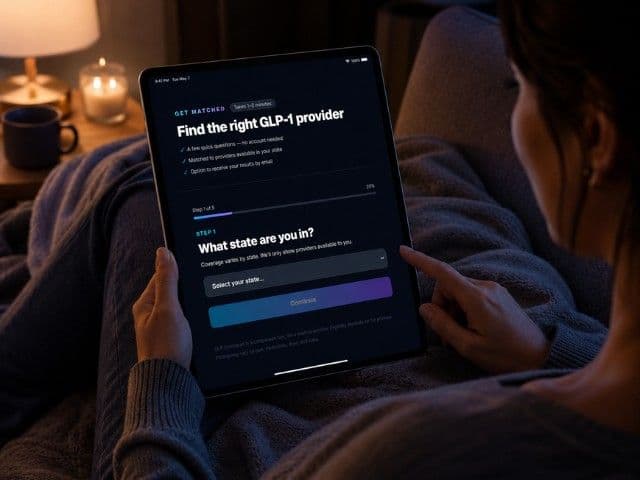
Use the match quiz to narrow providers by state, budget, medication format, and care preferences.
Already narrowed it down to a few providers? Compare them side-by-side →
Compare Providers Using Fit, Cost, and Trust
Once you’ve narrowed your list, it’s time to compare your top choices side by side across three areas: fit, cost, and trust.
Fit tells you whether the provider matches what you need. Cost tells you what you may actually pay, not just the advertised starting price. And trust shows you whether the provider experience looks clear, reliable, and easy enough to deal with after signing up. The bar for customer service is pretty low in this industry, so if you have a smooth intake process and your medication arrives on time every month, that’s really what you should be after.
Not sure where to start?
Already have two providers in mind?
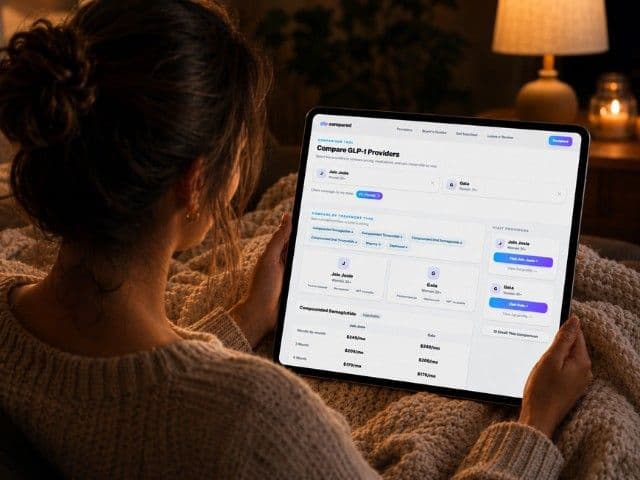
You can compare GLP-1 providers side by side using our comparison tool. It helps you look at pricing, medication options, state coverage, and care model in one place.
Fit: Does the provider match what you need?
There are plenty of providers that will fit your needs, but not all of them will. Finding the right one can be tricky, but it all starts with state coverage.
From my experience researching providers, most of them list which states they cover in their FAQs. And if I ever come across one that doesn’t list where they operate, I’ll fill out their contact form or send an email. Once confirmed, I add it to our database. Now, on all of our free tools, users are able to filter “Check coverage for my state.”
After state coverage confirmation, you’ll want to start browsing their medication format, program type, consult type, follow-up support and refill process.
To do this manually, you can visit all the providers’ websites that fit your needs, then gather the information on their program. This will include medication types you’re interested in, what’s included, if it requires an on-going membership fee, how refunds and refills work and any other fine print.
To speed up the process, you can use our Browse Providers tool to get everything in one place, and eventually compare your top choices. We have all the factual details on each provider, and regularly review every two weeks because pricing changes constantly around GLP-1s. It’s also hard to manually write down pricing plans - advertised prices vs what you actually pay.
Cost: Can you understand what you will actually pay?
Plans and pricing can get confusing fast when it comes to GLP-1 providers. There are many different ways these brands are pricing their services. Many of them will have a promotion for the first order.
For example, Remedy Meds offers a $120 first-month discount, then the price increases to “standard pricing.” It’s a sweet deal for the first month, but consumers need to be aware that the next month they’re paying $299/mo or $399/mo, depending on which medication you’re approved for.
Then there’s the bulk orders, mainly in 3-month, 6-month or 12-month bundles. Rather than showing what’s due today, most brands will show the monthly equivalent (advertised price). So, you might see “As low as $179/mo” but the actual price you pay is $2,148 because it’s a 12-month plan, paid upfront.
Dose increases are another pricing point that differs from provider-to-provider. Some companies will have a titration schedule, and price goes up in relation to dose increase, while others have the same flat rate, regardless of dose.
Membership fees can be hidden, and sometimes it explains why these GLP-1 providers have “lower” prices compared to others. If a program has a membership fee, the customer will pay $x/mo on top of the medication costs. On the outside, it looks like you’re saving money because the medication price is low, but in reality it can be the same cost as a different provider that doesn’t charge a membership fee.
Manually researching pricing by yourself can be very time consuming, confusing, and most of the time… frustrating. This is one of the most important reasons I created glp compared. Our team regularly checks pricing every two weeks on each GLP-1 provider we have in our system. This allows users to shop smarter, faster and confidently.
Trust: Does the provider experience look reliable?
Trust has to do with more than a rating on trustpilot or Google. User reviews are great for finding patterns, but my research indicates many “verified” reviews are incentivized in this industry.
Before choosing, you’ll want the full picture of a provider, then research user reviews after. Here’s what to look for:
- Legitimate intake form that asks the right questions
- Transparent pricing
- Clear refill process
- Program policies
- Refund and cancellation terms
- Pharmacy and fulfillment details
- Provider support, messaging, response time
- User feedback - reviews are useful for spotting patterns, not making the whole decision
Gathering this information, and if it’s clearly laid out on the provider’s website, will tell you if it’s a legitimate operation or not.
We’ll only add providers that have all of this information publicly, and if they don’t have it publicly, we’ll reach out. If we get an accurate answer, and we have everything we need, we’ll list them on glp compared.
If our tools helped you decide, or if you want to leave feedback on a specific provider, we have a user feedback system where you can leave a review. This helps future shoppers get inside information from people who have actually used the provider.
When Should You Use a GLP-1 Provider Comparison Tool?
Use a comparison tool when you’ve narrowed down two to three providers and want to compare pricing, medication options, state coverage, and care model side-by-side.
What the comparison tool is best for:
- Comparing pricing and plans, and everything else in once place
- What’s included vs what’s not
- Useful before clicking through to a provider
- When you’ve narrowed down your list to 2 or 3 providers
What it doesn’t do:
- It doesn’t replace reading the provider profile or fine print
- It won’t choose for you, you’re still making the key decisions based on fit
When Should You Read Individual Provider Profiles?
Read provider profiles when you’re starting your research or you want more details about one specific provider before signing up.
A useful provider profile lays out all the factual information, such as plans and pricing, medication options, consultation process, support, pharmacy details, and who the provider may fit.
As an example, let’s say you’ve narrowed your list down to three providers: Willow, Join Josie, and Gala.
All three brands cater to women, but their plans, pricing and care model differ drastically. This would be the perfect time to quickly scan each provider page, looking for the best fit.
Using our GLP-1 provider browsing tool, I would start with Willow and get a feel for what they offer and what the prices are. Then check out Join Josie, you’ll be able to see the differences really quickly. Finally, I would scan Gala GLP and at that point I would have a pretty good idea of what each provider offers and which ones I want to compare side-by-side.
When Should You Read Written Provider Comparisons?
Read a written comparison when you’re deciding between two specific GLP-1 providers and want more context than a table can show. A helpful written comparison will show some first hand experience, like going through the intake process, communication with customer support and sometimes getting all the way to delivery and inside the patient portal.
Hearing from someone who actually went through the intake process, will give you more insight to what the weight loss program is all about. This can include differences of price, care model, medication format, support and better fit.
I’m constantly filling out intake forms, because most of the time, that’s where the pricing reveals are. A lot of providers don’t list their prices, they make you wait all the way up to checkout.
Our written comparisons are located on the compare GLP-1 providers page, below the tool. These take a lot of time and effort, but we’re constantly adding more.
What Should You Check Before Signing Up?
Before signing up, you should confirm state coverage, pricing, what’s included in your plan and compare at least one other provider.
Use this short checklist:
- Does the provider serve your state?
- Does it offer the program format you want?
- Do you understand the monthly price and due-today cost?
- Are medication, consults, and support included?
- Are pharmacy or fulfillment details clear?
- Do user reviews show repeated issues?
- Are cancellation and refund terms easy to find?
- Have you compared at least one other provider?
If you are still not sure where to start, use the match quiz. If you already have providers in mind, compare them side by side.
Not sure where to start?
Get Matched
Find GLP-1 telehealth providers that serve your state, fit your budget and offer what you're looking for.

About the author
Alex has been researching and comparing GLP-1 telehealth providers since 2020, before the market expanded into hundreds of competing brands. He goes through provider intake forms directly, contacts customer support teams, and reads the fine print on pricing, pharmacy partnerships, and policies before anything gets published.